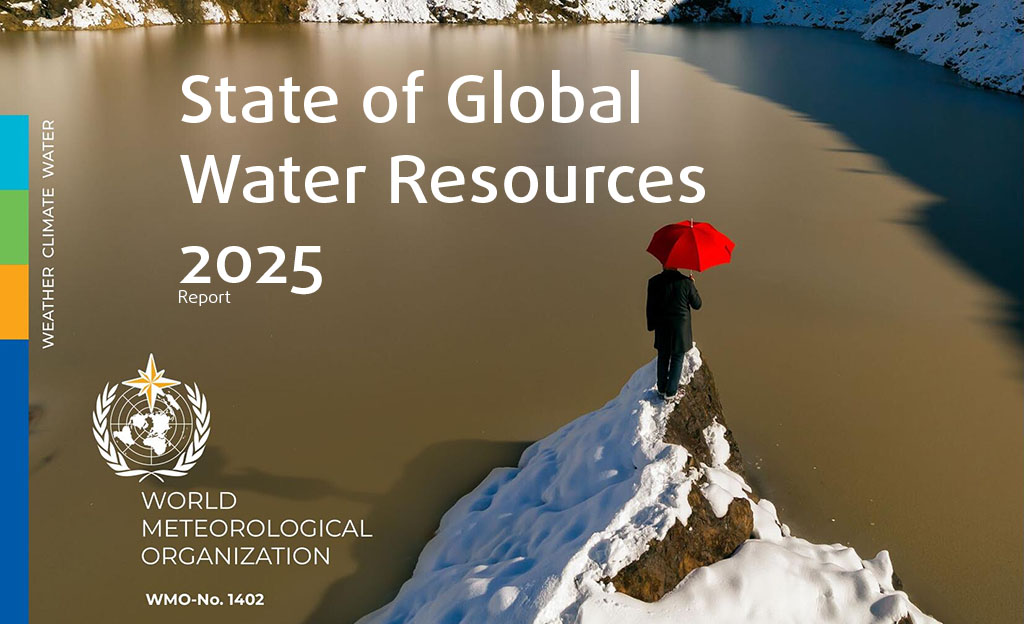
The new World Meteorological Organization (WMO) report, State of Global Water Resources 2025, shows that the global water cycle is changing faster than water management systems can adapt. The WMO estimates that 2025 was one of the driest years for global river flows in the past 35 years, while the last seven years have seen the lowest number of rivers with near-normal flow conditions since comparable assessments began in 1991.
The report covers precipitation, river flows, groundwater, soil moisture, evapotranspiration, snow, ice and terrestrial water storage. It particularly warns of the continued decline in terrestrial water storage and the fourth consecutive year of widespread glacier mass loss. The impacts are not the same everywhere: some regions face water shortages and low flows, while others experience intense precipitation, flooding and deteriorating water quality.
Such variability is changing the fundamental question of water management. It is no longer enough to ask how much water we have; we also need to ask when water is available, what its quality is, and whether water systems can withstand simultaneous pressures from drought, floods, pollution, water abstraction and changes in land use.
The report of the Croatian Institute for Water, State and Changes in Water Resources in the Republic of Croatia 2022–2024, shows why the WMO’s warnings should not be reduced to the question of available water quantities alone. Monitoring results confirm that the condition of Croatia’s waters varies among rivers, lakes, transitional waters, coastal waters and groundwater, and that both ecological and chemical status need to be monitored simultaneously. In river systems, ecological assessments remain challenging, while persistent pollutants detected in biota continue to be among the recurring challenges affecting chemical status.
Groundwater, meanwhile, generally maintains favourable chemical status, but persistent local pressures are recorded in certain areas, ranging from chlorides in the Adriatic River Basin District to nutrients, metals and chlorinated solvents in the Danube River Basin District. This is the Croatian dimension of the WMO’s findings: a more variable water cycle increases the need to view water as an interconnected system – in terms of quantity, quality, timing of availability and ecosystem resilience – rather than through a single indicator or at a single location.
The WMO report provides the global framework: the water cycle is becoming more variable, while hydrological extremes are becoming increasingly important for the security of societies and economies. National monitoring shows what this variability means in specific Croatian water systems: from the ecological status of rivers and chemical pressures to the protection of groundwater and coastal ecosystems.
The response therefore needs to focus primarily on management: continuous and comparable monitoring, protection of water sources and groundwater, reducing pressures on surface waters, preserving aquatic and water-dependent ecosystems, and incorporating water-related risks into spatial planning, agriculture, energy and infrastructure development. In a more variable water cycle, water security depends on the quality of data, timely action and the ability to manage water at the level of the entire river basin, rather than at individual locations alone.
The full WMO report, State of Global Water Resources 2025, is available at the
WMO Library.